ADA sink design includes how bathroom sinks will be positioned and installed to make them accessible. This is especially important in hotels and other commercial buildings where all compliance, usability, and operational efficiency must converge.
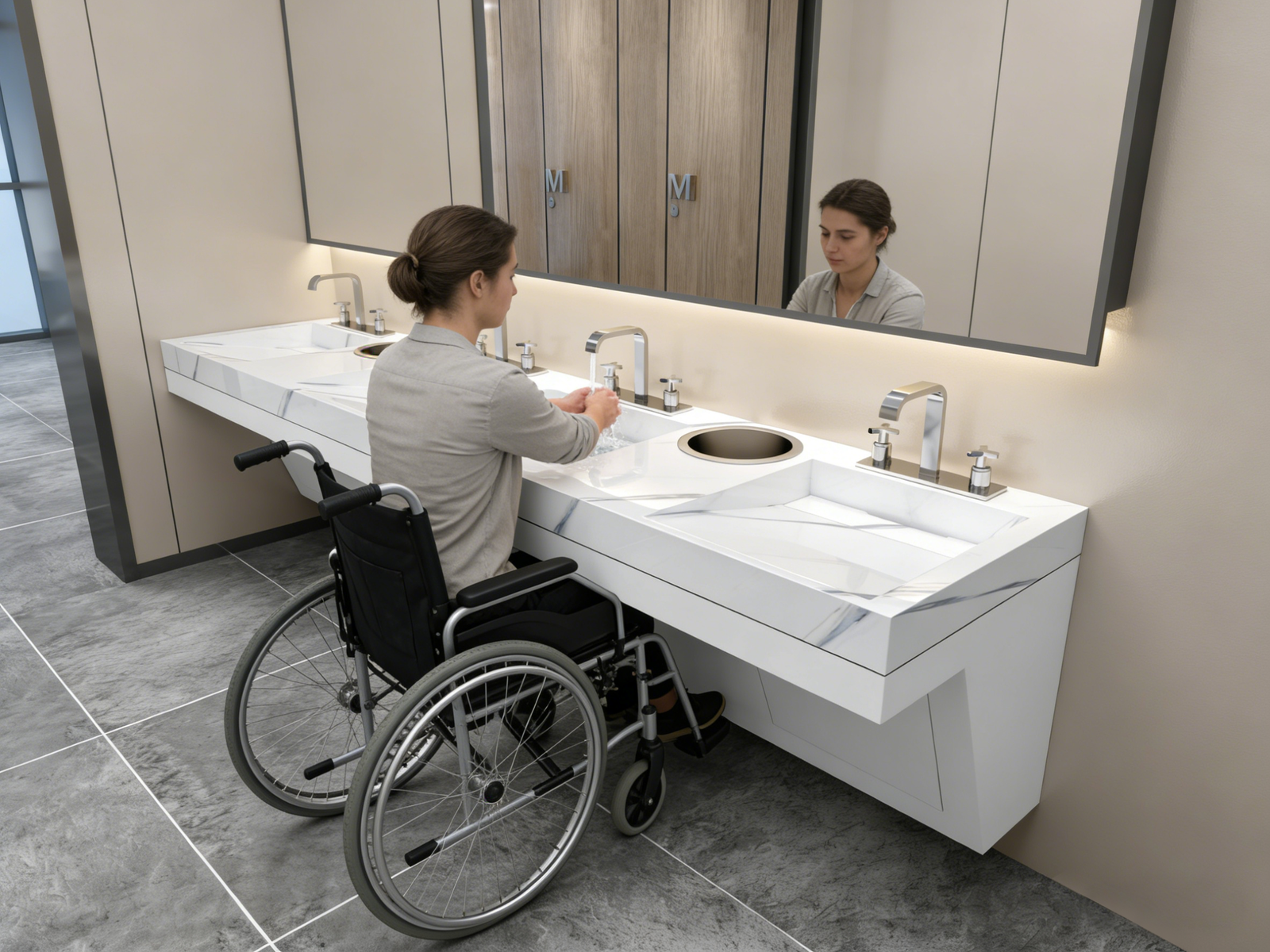
A sink may meet ADA sink design dimensions on paper, but it could turn out inaccessible due to a lack of approach space or adequate clearance. Such errors are most often noticed during inspection or after handover, making their correction costly and inconvenient.
Such errors spread rapidly in hotel construction and other large commercial buildings because once one layout flaw is made, it is replicated in several bathrooms.
This guide focuses on designing an accessible bathroom through a more project-specific approach.
What Is ADA Sink Design?
ADA sink design means creating and outlining bathroom sinks that are not only accessible but also safe and convenient for people with disabilities, especially in commercial and public places.
It is not only about picking a compliant fixture. ADA compliant sink design is a reflection of how a sink is arranged in relation to the whole ADA bathroom layout, including height, clearance, reach range, and user approach.
Basically, a sink design has to fulfill the following ADA sink requirements:
- Height alignment: Makes sure the sink is at hand level
- Clear space below: Allows proper knee and toe clearance
- Accessible controls: Faucets should be operable with one hand
- Unobstructed approach: Users should be able to move freely
It is possible that a sink meets individual measurements and still fails if these elements are not well coordinated. This is where many projects encounter issues.
After the sink installation, any deficiency in clearance, spacing, or positioning can be corrected only through rework.
Sink Spacing Guidelines for Commercial Bathrooms
Sink spacing decides how comfortably several users can access the space, how fast the cleaning can be done, and whether the design can withstand peak usage.
In commercial bathrooms, especially in hotels and public facilities, sinks are hardly ever used one at a time. Visitors come in either consecutively or simultaneously, making the space quite a functional requirement.
Spacing Between Sinks
A sufficient distance between sinks allows each user to operate independently. When sinks are placed too close, user zones overlap, meaning the congestion at high-traffic periods goes up.
Clear spacing assists accessibility. There is a requirement for an ADA-compliant sink to have an unobstructed approach space. But when adjacent sinks are placed too close, that space is lost.
Multi-User Considerations
Bathroom designs in commercial settings must be designed to handle various users at once, which includes wheelchair users. The plan should include how their movement will overlap without hindering each other.
Poor spacing creates practical issues:
- Users waiting for access despite available sinks
- Difficulty in maneuvering mobility devices
- Increased contact between users in confined areas
These conditions reduce usability and affect overall flow.
Parallel vs Linear Layouts
Two common layout approaches are used in commercial bathrooms:
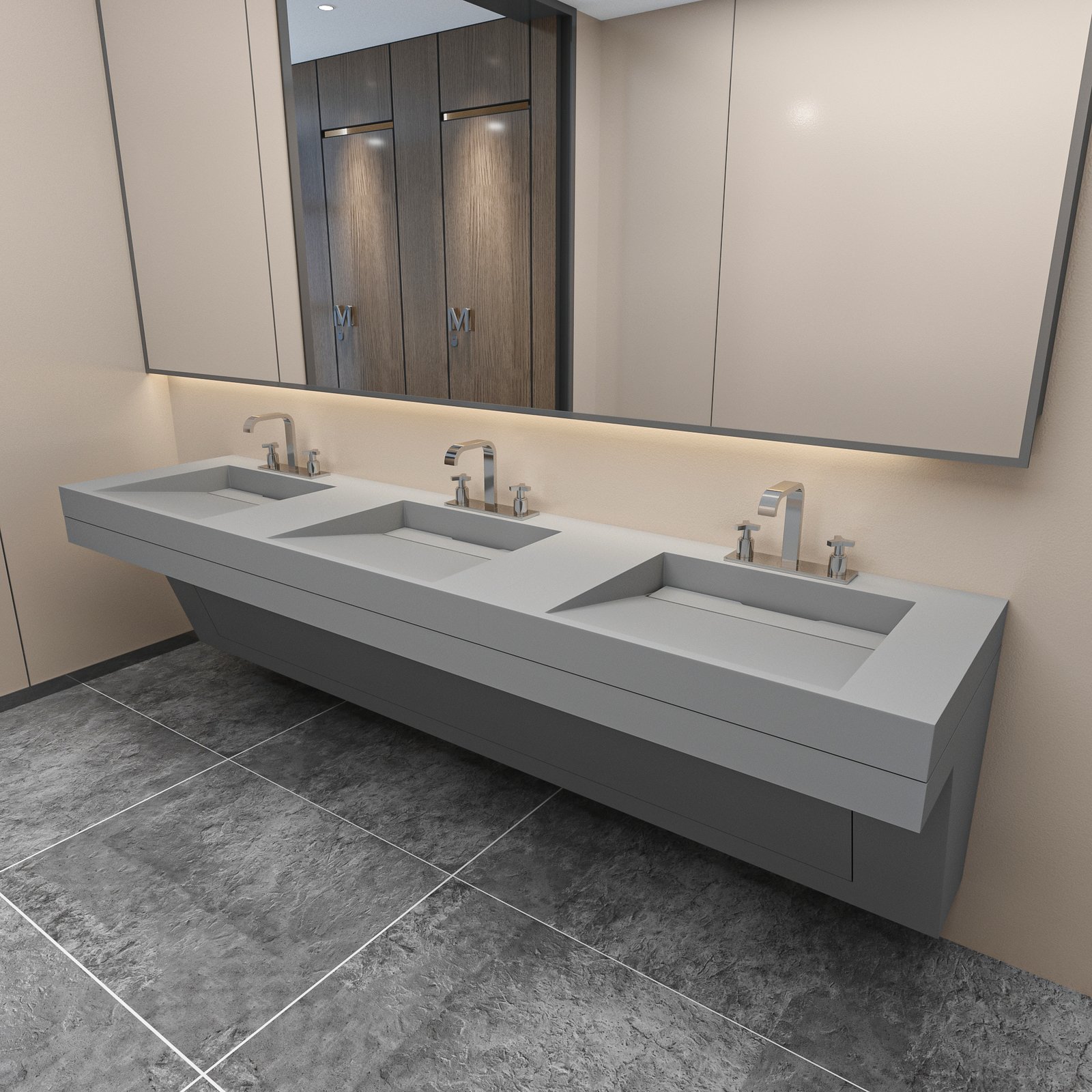
- Linear layout:
Sinks are placed along a single wall. This option is easy to design and can work efficiently in limited spaces. But spacing should be considered to avoid overcrowding. - Parallel layout:
Sinks are positioned on opposing walls. This arrangement facilitates circulation and prevents congestion in busy locations.
Designers should consider the available space and usage volume when deciding which configuration to adopt.
Avoiding Overcrowding
Congestion is a common problem in designing commercial bathrooms. This usually happens due to maximizing fixture count without considering usability.
More fixtures do not necessarily mean higher efficiency. In many instances, it only causes overcrowding
A well-spaced ADA bathroom sink layout allows:
- Clear user movement
- Faster access to sinks
- Easier cleaning between units
Once the fixtures are installed too close to each other, there is no way to rectify the spacing problem.
Proper spacing as per the ADA sink clearance requirements allows the bathroom to function effectively under any circumstances.
Designing Accessible Flow in Bathroom Layouts
Accessible bathroom design is determined by the way users navigate through it. The proper planning of the route will ensure smooth and safe navigation of users from the point of entry to the sink and further departure.
Entry → Sink → Exit Flow
A well-planned bathroom layout should have direct access from one point to another with minimal barriers. After entering the bathroom, one should be able to easily go to the sink.
This is going to be important in the design of the ADA sink, considering that wheelchair users require space for movement.
A functional flow ensures:
- Direct approach to the sink
- Sufficient space to position and use the fixture
- Clear exit without backtracking
If this sequence is disrupted, the sink will meet all the technical requirements but will be practically unusable.
Avoiding Congestion
Congestion usually occurs near sink entrances. This results from improper planning when there are overlapping spaces where users’ movements intersect.
Common causes include:
- Sinks placed too close to entrances
- Insufficient space between fixtures
- Poor alignment of circulation paths
Congestion leads to decreased accessibility, making this process much more complicated. It becomes especially crucial for everyday operations.
User Movement Logic
Every ADA bathroom sink layout must be planned according to natural movement. This includes:
- Forward approach to fixtures
- Turning space for mobility devices
- Clear separation between user zones
Neglecting the logic of movement will result in efficient-looking designs that ultimately do not work in reality.
After the design is finalized and construction is completed, any problems with movement cannot be fixed unless there are alterations to the structure.
An excellent accessible bathroom layout design guarantees proper movement flow that is efficient, intuitive, and meets ADA guidelines under practical use conditions.
Wall-Mounted vs Countertop Sinks: Which Is Better for ADA Compliance
Sink type directly affects how easily ADA sink requirements can be achieved. Wall-mounted and countertop sinks can both be used in a commercial bathroom design project, although their influence on clearance, installation, and usability will be completely opposite.
The selection should account for the performance of the sink in a practical ADA bathroom layout, especially concerning clearance.
| Factor | Wall-Mounted Sinks | Countertop / Integrated Sinks |
| ADA Compliance | Easier to achieve | Requires careful design and coordination |
| Knee Clearance | Naturally open and unobstructed | Often restricted by cabinetry |
| Installation Complexity | Lower | Higher due to multiple components |
| Design Flexibility | Limited | High |
| Maintenance Access | Easy to clean underneath | Restricted access in enclosed areas |
| Risk of Non-Compliance | Low | Higher if not detailed correctly |
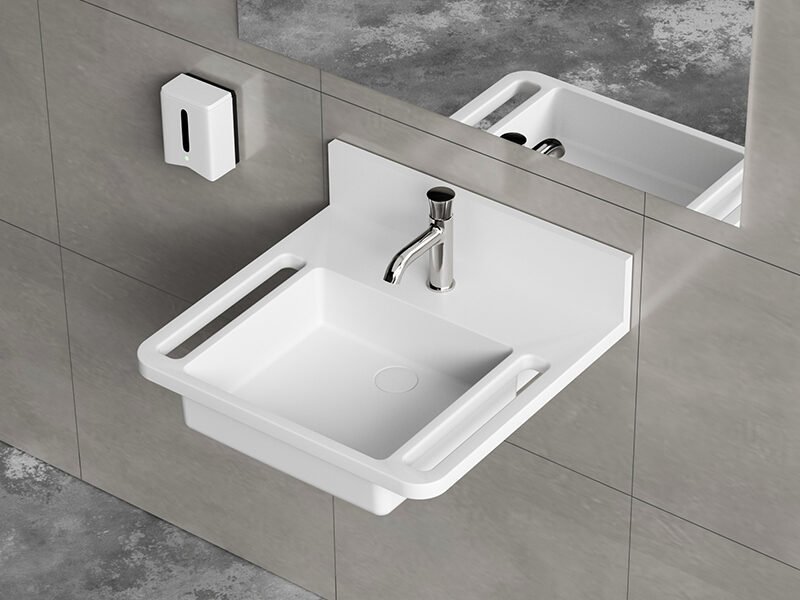
Wall-mounted sinks are more likely to ensure ADA compliance since they minimize the risk of clearance space. Nonetheless, countertop sinks may also be applied if the design guarantees that all ADA requirements are met.
A problem with either clearance space or height limit cannot be solved after countertop installation without the removal and reconstruction of the unit.
Best Materials for ADA-Compliant Bathroom Sinks
Materials with high susceptibility to staining, cracking, or other damage require frequent maintenance, which can cause many problems. In commercial settings, sinks must be easy to clean. Materials that stain easily, develop joints, or degrade over time create operational challenges that cannot be resolved through layout changes.
Material affects:
- Hygiene performance
- Cleaning efficiency
- Resistance to wear
- Long-term consistency across units
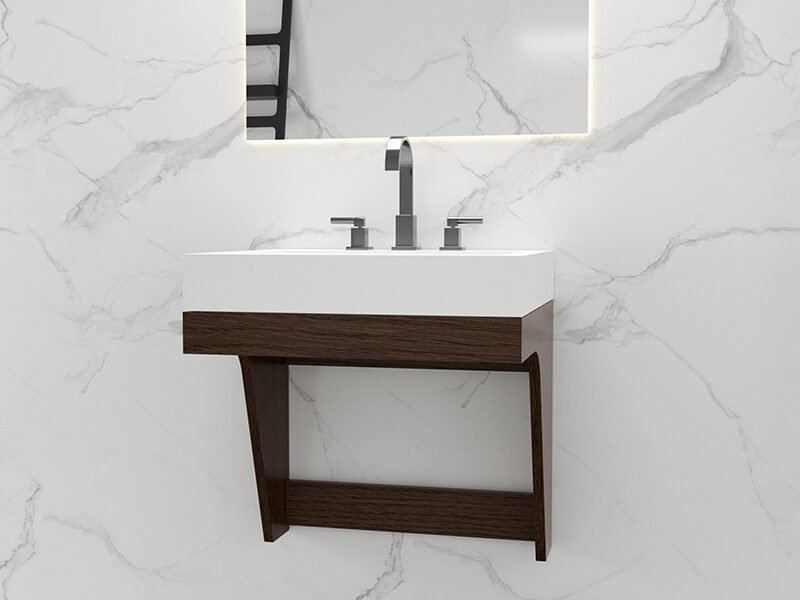
Choosing the wrong material brings about issues that affect the installation throughout its lifetime.
Solid surface is one of the materials often used for accessible bathroom installations because it solves most of the problems right from the start.
- Non-porous surface:
Prevents water penetration or discoloration, making cleaning more efficient without harsh chemicals. - Seamless fabrication:
Aids in the seamless integration of fixtures and eliminates areas where dirt accumulates easily. - Repairable and refinishable:
Damaged parts of the material can be refinished to ensure efficiency over time. - Consistent quality:
Engineered manufacturing guarantees a consistent look and performance in all installations, which is essential in hotels.
Material selection directly affects operational outcomes.
Design Tips for ADA-Compliant Sinks in Hotels and Public Spaces
Designing ADA-compliant sinks in hotels and commercial spaces doesn’t stop at dimensional standards. Every decision made will have an impact on usability, ease of cleaning, and consistency in design across all sinks.
- Consistent installation across units: Ensures uniform user experience and maintains brand standards across rooms or facilities
- Open space below the sink: Ensures knee space is maintained and provides increased accessibility for wheelchairs
- Avoid enclosed cabinets: Prevents blocking the knee space requirement
- Utilize durable, non-porous materials: Increases sanitation ability and decreases future maintenance requirements
- Maintain clear approach space: Allows users to access the sink without obstruction or congestion
- Standardize mounting height: Prevents variation during installation and ensures consistent compliance
- Plan for easy cleaning access: Reduces time required for maintenance and improves operational efficiency
Each of these decisions will ensure that the ADA sink design works in practice and not just on paper. ADA-compliant sink design in hotel and commercial spaces should take into consideration accessibility and efficiency.
ADA Sink Design Checklist
Use this checklist during the specification and layout stage to ensure the sink design performs correctly after installation:
 Sink height Sink heightMaximum 34 inches from finished floor to ensure accessible reach Knee clearanceMinimum 27 inches height with adequate depth for wheelchair positioning Clear floor spaceUnobstructed area in front of the sink for direct approach Faucet operationOne-hand operable without tight grasping or twisting Pipe protectionInsulated or covered to prevent burns and injury Wall-mounted preferenceMaintains open space and reduces risk of blocked clearance Spacing between sinks:Prevents overlap of user zones in multi-user environments Accessible layout flow:Clear path from entry to sink and exit without obstruction Material selection:Non-porous and seamless surfaces for hygiene and easy maintenance Consistent installation:Uniform height and alignment across all units in the project |
Each point should be verified before installation. Once the sink is installed, most compliance issues cannot be corrected without rework.
Plan ADA-Compliant Bathroom Sinks with KKR Bath
KKR Bath offers commercial and hospitality project assistance with high-level manufacturing skills and prior experience. Every single product is designed with great accuracy to keep the same specifications in all units, minimizing installation risks.
Customizing is a part of the process itself. The sink products can be customized in size, configuration, and in accordance with ADA clearances. Project managers will be able to consider the aspect of accessibility without damaging the design itself.
Efficient production and strict quality control will guarantee that each unit will have the same high level of accuracy and quality.
Get in touch with KKR Bath to discuss your ADA sink design needs and create the right solutions.
FAQs
1. What is ADA sink design?
ADA sink design is all about creating and fitting in sinks in a manner that will conform to the standards of height and clearance requirements.
2. What is the ADA sink height requirement?
The highest point should not exceed 34 inches above the finished floor surface.
3. Can ADA-compliant sinks have countertop installations?
Yes, if the correct height and knee clearance requirements are satisfied without any interference.
4. How does one provide clearance for ADA-compliant sinks?
This can only be possible through the provision of knee and toe clearance for comfort and safety.
5. Which type of sink material can be used for ADA compliance?
Non-porous and seamless materials, such as solid surface, are advisable.