
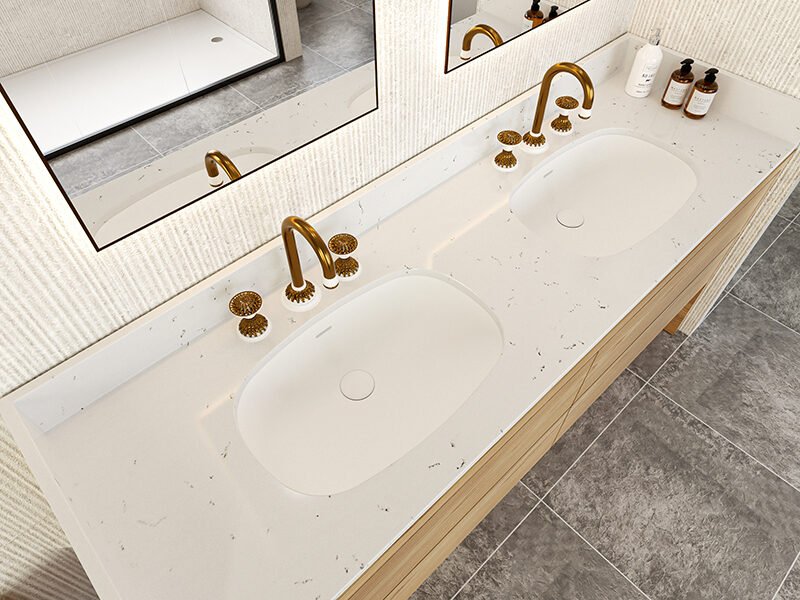
Bathroom countertops, also known as vanity tops, are an essential in every type of modern construction project; hotels, apartments, or another type of commercial development. The bathroom countertops that you choose will directly affect the durability, hygiene, and overall design consistency of the project.
Bathroom vanity tops are more than just decorative surfaces. They are used daily and are constantly being touched and exposed to water and cleaning chemicals.
So, choose wisely because the bathroom materials you install have to endure heavy use but still maintain their appearance over time.
To help you get ready for a successful project, we have created this bathroom countertops guide. In it, we explore the most commonly used countertop materials for hotel bathrooms, the styles, and the project application.
Overview of Bathroom Countertops
For you to select the best bathroom countertop options for your projects, you first need to understand what they are and the importance of the role they play in modern construction projects.
Bathroom countertops are more than just simple horizontal surfaces. When they are properly chosen and installed, these vanity countertops will instantly improve the design of the space and enhance its functionality as well.
Therefore, choose countertops that can support bathroom sinks, provide their users with space for daily use, and contribute to the overall layout of the bathroom.
In addition, the batbroom countertop should also be able to balance durability with visual appeal.
In commercial spaces, such as hotels, bathroom countertops are used quite often, and as a result, they are almost always wet from water splashes or cleaning agents used by staff. Consequently, they must be made from highly durable material.
To ensure long-term performance and low maintenance cost, for any project, bathroom countertops must be:
- resistant to water
- easy to clean
- durable enough for daily use
- consistent in appearance across multiple installations.
When you properly understand why these requirements are in place, then you will be able to make better decisions when selecting the right bathroom vanity top materials and designs for your project.
Common Bathroom Countertop Materials
When it comes to selecting bathroom countertops, choosing the best material for that specific project is one of the most important decisions you will make.
In most construction projects, developers typically choose either quartz countertops, granite countertops, solid surface countertops, or ceramic or porcelain surfaces.
These materials are the most commonly used options for bathroom sanitaryware. Each of them will provide you with a variation of benefits in terms of durability, maintenance requirements, cost, and design flexibility.
This means it is important for you to understand how they compare so that you can choose the most ideal material for your project.
For the purpose of this guide, we will focus on the four top bathroom vanity top materials.
- First is quartz countertops. These are engineered surfaces that are known for their durability and consistent appearance.
- Next is granite countertops. These are made using natural stone materials, and they give the space a more premium look. But granite countertops tend to require additional maintenance.
- Third are solid surface countertops. These are widely used in modern projects because they are non-porous and seamless, making them easy to maintain.
- Lastly, we have ceramic and porcelain surfaces. These are the most traditional options. They are chosen quite often because they are cost-effective and resistant to heat and chemicals.
These four types of materials are all really good options for commercial bathroom countertops. The right choice will depend on a list of factors such as your budget, the client’s design goals, maintenance expectations, and the level of usage in the space.
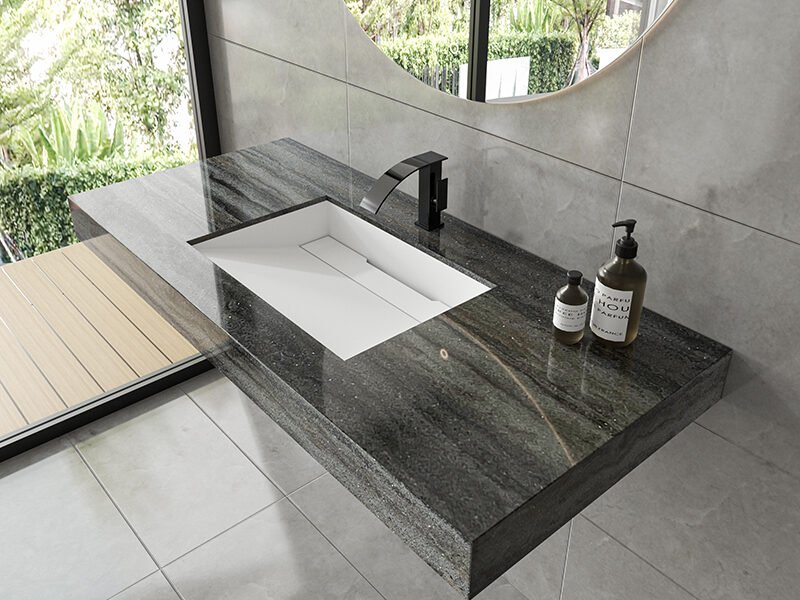
Quartz Countertops
Quartz countertops are engineered stone surfaces. These are made from natural quartz crystals, combined with resins and pigments to create a dense, non-porous material. Quartz is a highly moisture-resistant and stain-resistant material.
With those qualities, quartz is rated as one of the best materials for bathroom construction projects and, as a result, is widely used in both hotel and residential bathroom projects.
Installing a quartz bathroom countertop will offer your clients and their guests durability, consistent color, and a uniform appearance across multiple units. These are very important benefits for large-scale developments.
In addition, quartz surfaces require minimal maintenance even in high-use environments.
Granite Countertops
Granite stones are mined directly from quarries. They are then shaped and polished to make countertops that are natural stone surfaces.
Also, granite vanity tops offer a premium and high-end appearance. So, they are most frequently chosen for luxury hotel and residential projects.
The downside to using granite is that it is a porous material. Therefore, unlike engineered materials, granite will need to be sealed in order to be resistant to moisture and staining.
Furthermore, although granite is a very durable material, it does require more maintenance compared to other materials.
Solid Surface Countertops
Solid surface countertops are extremely resistant to moisture, stains, and bacteria. They are made by combining a mixture of resins and natural mineral fillers. This combination results in a material that is commonly used in commercial bathrooms because it is non-porous and homogeneous.
One of the main reasons why solid surface countertops are the top choice for hotel bathroom construction projects is their ability to be made into seamless designs.
Solid surface’s seamless ability allows it to be turned into an integrated sink countertop solution. Seamless designs improve hygiene and make cleaning bathroom vanity tops so much easier.
In addition, it can be repaired on the spot to remove those minor scratches or damage. With a little sanding and polishing, it can look as good as new, and this helps extend the lifespan of the material.
Ceramic and Porcelain Countertops
Ceramic and porcelain countertops are another popular choice. These are made from clay-based materials that are heated at high temperatures.
Ceramic and porcelain create a hard and durable surface, and that makes these materials ideal for bathroom applications. They are also resistant to heat, chemicals, and moisture.
They are also cost-effective and easy to find, and this is why they are suitable for budget-conscious projects.
However, they typically do not offer the seamless design and flexibility that you get from solid surface materials. Also, depending on the design that is chosen, installation may involve visible joints.
These four material types represent the most commonly used options in bathroom countertop applications. Each one offers different benefits, and your final selection should be based on the specific requirements of your project, including durability, maintenance, design, and cost.
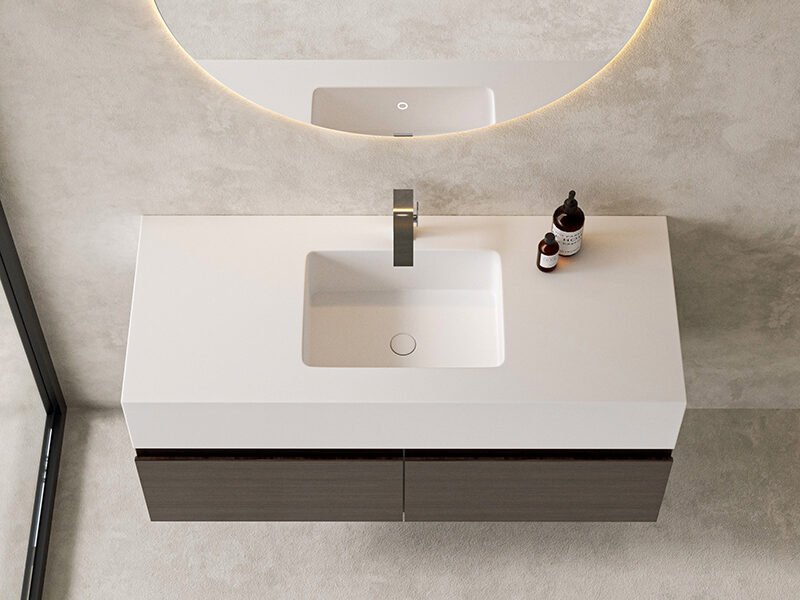
Material Comparison for Bathroom Countertops
Material Comparison Table
| Material | Durability | Moisture Resistance | Maintenance | Design Flexibility | Typical Use |
| Quartz | High | Non-porous | Low | Moderate | Vanity tops |
| Granite | High | Porous (requires sealing) | High | High | Luxury projects |
| Solid Surface | Very high | Non-porous | Low | High (seamless designs) | Countertops, integrated sinks |
| Ceramic / Porcelain | High | High | Moderate | Low to moderate | Budget applications |
How to Use This Comparison
Each of these materials can perform well in bathroom environments. However, the appropriate choice really depends on your project requirements.
If your priority is low maintenance and hygiene, then opt for the non-porous materials such as solid surface and quartz.
If you are working on a luxury project and want the space to have a natural aesthetic, granite may be suitable. But you should bear in mind that granites will require additional maintenance.
Some projects’ priority is cost efficiency. Therefore, ceramic and porcelain materials can be a practical choice. Although, they may offer less flexibility in design.
Advantages of Integrated Sink Countertops
The use of integrated sink countertops is one of the most practical developments in modern bathroom design. This design eliminates the need for installing the sink separately from its vanity top.
Instead, the sink and the countertop are merged into a single unit, which is quite practical for hotels and other high-traffic environments. Here are the main benefits of integrated sink countertops:
Improved Hygiene
Integrated sink countertops have no joints or seams around the basin area. This means that there are very few places for dirt and other debris to accumulate.
Its integrated design makes it easier to maintain higher hygiene standards. This is especially important in hospitality environments.
Easier Cleaning and Maintenance
There are no gaps between the sink and the countertop. Due to the seamless design, integrated sinks are much easier for housekeeping staff to clean the entire surface with more efficiency. Furthermore, the design helps to reduce cleaning time and ensure that the bathroom remains clean.
Reduced Risk of Water Damage
Traditional sinks are made with seams. Over time, water can seep through those seams. But an integrated sink countertop can significantly reduce that risk because the surface has a continuous layout.
This helps to protect the cabinetry and its surrounding materials from moisture damage.
Modern and Seamless Design
Integrated sink countertops also provide a modern appearance. Their seamless design aligns well with the more contemporary bathroom styles and creates a more uniform look across multiple rooms.
This is why integrated sink countertop solutions are becoming so popular in hotel construction projects.
Countertop Solutions for Hotel Bathrooms
Selecting the right bathroom countertops for your hotel projects takes a lot of consideration because you must think about a lot more than just appearance. Hotel bathrooms tend to experience a lot of traffic, and this means that the materials and designs you choose must be able to perform under constant use.
Durability for High-Traffic Environments
Over time, hotel bathrooms will start to exhibit visible wear and tear on their surfaces because they are used by multiple guests daily.
Consequently, as a developer, you should prioritize materials that are durable. Look for the ones that are designed for commercial use. Choosing the right materials will help to reduce the need for early repairs and replacements. In turn, this will lower long-term costs.
Hygiene and Maintenance Requirements
Bathroom countertops must be easy to clean. They also need to be resistant to stains, moisture, and bacteria because in hotel environs, cleanliness is a major priority.
When you use non-porous materials, such as solid surface countertops, you are helping to promote cleanliness. Non-porous materials prevent water absorption, and they make cleaning and maintaining higher hygiene standards across all rooms simpler.
Consistency Across Multiple Rooms
In hotel construction projects, the bathrooms typically all look the same because the same design is used for almost every room. Therefore, being able to maintain consistency in materials and design is essential.
To achieve this high level of consistency and prove your professionalism, it is best that you work with suppliers who have proven their ability to provide uniform products.
These items must maintain the same appearance and level of performance. This helps to support you and your clients’ brand standards and ensures a consistent guest experience.
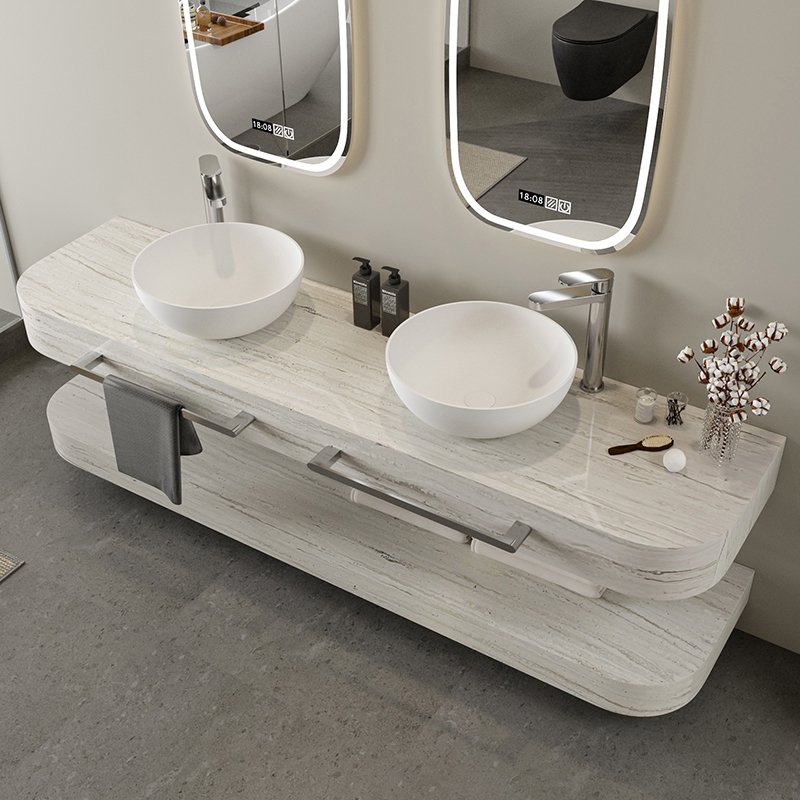
Why Solid Surface Countertops Are Widely Used
Solid surface countertops are commonly used in hotel bathrooms because of their consistent balance of durability, hygiene, and design flexibility.
Their seamless design allows manufacturers to create integrated sink countertop solutions that ultimately simplify the cleaning process and improve hygiene. In addition, they can be customized to fit different layouts and still provide a consistent appearance across all units.
Bottom Line
Selecting the best bathroom countertops is an important part of any construction project. Whatever the project, the materials and designs that you select will directly impact the overall performance of the bathrooms.
For that reason, bathroom countertops have to be able to go through constant exposure to moisture and cleaning products. Even with this daily and constant use, bathroom vanity tops must remain aesthetically pleasing over time.
Because of this, it is important for you to carefully evaluate each material and design option based on the requirements of your project.
Frequently Asked Questions
- What are the most commonly used bathroom countertop materials?
In most construction projects, developers typically choose either quartz countertops, granite countertops, solid surface countertops, or ceramic or porcelain surfaces. These materials are the most commonly used options for bathroom sanitaryware, and each of them will provide a variation of benefits in terms of durability, maintenance requirements, cost, and design flexibility.
- Why are solid surface countertops popular for hotel bathrooms?
Solid surface countertops are commonly used in commercial bathrooms because they are non-porous and homogeneous. Their seamless design allows them to be turned into an integrated sink countertop solution, which improves hygiene and makes cleaning easier. In addition, they can be repaired on the spot with sanding and polishing, which helps extend the lifespan of the material.
- What are the benefits of integrated sink countertops?
Integrated sink countertops eliminate the need for installing the sink separately from its vanity top. Because there are no joints or seams around the basin area, there are very few places for dirt and debris to accumulate, making it easier to maintain higher hygiene standards. This design also makes cleaning more efficient and reduces the risk of water damage.